Showing posts with label Movie Reviews. Show all posts

Monday, February 24, 2014

Movie Review: The Lego Movie (2014)


I can't believe I'm saying this, but I very much enjoyed The Lego Movie. (And I think that may be a gross  understatement.)

Scott and I saw it with our two daughters (yes, girls!) on Friday night. All of us had to talk ourselves into seeing it (I bribed the girls with popcorn), but we all more or less LOVED it. We may have enjoyed it so much, in part, because our expectations were extremely low, but three days later I find that I keep thinking about it and singing the ridiculous, irresistable, and aptly named theme song, "Everything Is Awesome!"

I had read one review in advance with a spoiler alert about the ending, which I will not reveal. The review intrigued me enough to compel me to see it, though. Almost all of the reviews have been over the top in favor of the movie. This Lego Movie (as opposed to others that have been released directly to DVD) is targeted to all age groups and both genders. It was not made just for little boys who currently play with Legos.

Some of the things I loved about it:
  • lots of humor and almost no potty humor
  • the inclusion of all of the major types of Lego sets -- Wild West, Star Wars, astronauts, skyscrapers...
  • the inclusion of a little romantic intrigue (always a plus when it's well done)
  • Batman's personality
  • Morgan Freeman in a semi comic role
  • the whole premise
  • the fun twist at the end, which brought clarity to the whole film
  • no cursing of any kind, which is quite amazing for a Will Farrell movie (and I do not usually like Will Farrell movies. Despised 'Elf,' for example.)
The Lego Movie is all about creative freedom and individuality. No wonder it was so great!

My only complaint about it is that the special effects were a bit off-putting, but the story made up for it, as a compelling story always does.

Saturday, November 26, 2011

Movie Review: "Moneyball"


We went to a matinee this afternoon to see "Moneyball," starring Brad Pitt, who also produced the film. It was excellent! I can't say enough about it, really. Go see it, if you can. Rent it on DVD when it comes out. It is well worth your time.

Moneyball tells the true story of the 2002 Oakland A's and how they re-engineered their approach to fielding a team because they could not afford the Yankees' business model of paying top dollar to great players. The general manager, Billy Beane, played by Pitt, teams up with a Yale economics graduate/baseball fan to select players based on a complicated computer analysis. The team's scouts and manager vehemently oppose the idea, and the players don't take it very seriously either, until Beane shakes things up. Suddenly they are winning -- in fact, they start breaking records for wins. It's very exciting.

But the movie isn't strictly about baseball. It also addresses Beane's relationship with his 12-year-old daughter, whom he quietly adores. Baseball is used as a metaphor for what happens when a person believes in himself, or fears failure. It's a great, great movie.

[In the interest of full disclosure, I must confess that I was once a baseball junkie. For three years of my life (ages 13-16), 3rd baseman Hall of Famer George Brett and the Kansas City Royals were my drug of choice. I went to as many games, grand openings, and ribbon cuttings as I could and baked cookies for George at Christmastime. I subscribed to the Sporting News and Sports Illustrated and carefully clipped every picture and article from the Kansas City Star to paste in my scrapbook. George Brett posters adorned the walls and ceiling of my bedroom. I even followed the team on a road trip to Chicago, staying in the same hotel. Yes, I was a groupie.

Little did I realize that despite our seemingly insurmountable age difference of 11 years, George would eventually marry a girl three years younger than me. Alas, I was too old for him!]

Tuesday, December 28, 2010

Movie Review: "True Grit" (2010 version)


Growing up at the tail end of the western movie era, there is something nostalgic for me about watching cowboys and indians or sheriffs and outlaws on the big screen. Some of my favorite television characters were Matt Dillon, Kitty and Festus. When "Silverado" came out in the '80s, I applauded the return of the western genre, but there have been very few westerns made since that time.

So when my husband suggested that we go see "True Grit" this afternoon, I wasn't opposed to the idea, even though "The King's Speech" was the next movie I planned to see. Somehow I missed the original "True Grit" and had the story line confused with "High Noon." I'm glad now that I did not know the story, because it was all fresh and unexpected.

It was one of the best movies I've ever seen. I was there, in that town on the edge of the frontier. I was 14-year-old Mattie, saddling up for an adventure, only mildly aware of the potential dangers ahead.

The story deals with vengeance, redemption, honor, and determination.

All of the acting was superb, especially Jeff Bridges as Rooster Cogburn. Phenomenal! He was completely believable. Matt Damon made an exceptionally fine Texas Ranger. Hailee Steinfeld as Mattie Ross was great, too. All of the minor characters, most of them outlaws, were absoltuely convincing. The casting was perfect.

And the writing was outstanding -- never too much. Sometimes I expected more information, because movies these days tend to spoon feed the audience, but I was pleased that this script did not attempt to explain self-evident details.

I expected the movie to be violent, but it was even more violent than I thought it would be. I also expected it to be suspenseful, and it definitely was. What I did not expect was humor, but it was full of humor as well. Cogburn's ramblings and his frequent squabbles with LaBoeuf were priceless.

When I walked out of the movie theater, I wanted to walk right back in again.

Monday, August 30, 2010

Movie Review: "Eat, Pray, Love"

As much as I wanted to like it, I found "Eat, Pray, Love" to be a pointless movie with a deceptively bad message.

Julia Roberts portrays the writer Elizabeth Gilbert, who ended a dissatisfying marriage and a subsequent rebound relationship with a younger man to live briefly in three countrries over the course of one year in an effort to 'find herself.' The three countries (all beautiful) were Italy, India, and Bali.

In Italy she focused on her physical need for food ("eat"); in India she lived in the ashram of an absent guru ("pray"); and in Bali she succombed to the advances of a wealthy Brazilian ("love") while valuing the advice of a charleton wiseman. That's the story line.

The acting was good, the scenery was nice...so what's not to like?

The main character (not Julia Roberts, but Elizabeth Gilbert).

I did not find Gilbert to be a sympathetic main character I could cheer for. She got off on the wrong foot with me by rejecting her husband of seven years for no apparent reason, despite his protestations. She had simply become bored with him and with married life in general and wanted out. Oh, sure, she is wracked with guilt about it for fleeting moments here and there, but finding herself is a much more important quest than rekindling their love. We, the viewers, are supposed to understand and champion her voyage of self-discovery.

When she decides to leave him, she kneels in prayer and tells God that though she has never prayed before she hopes he [God] knows of her 'ample gratitude.' Bingo! That is exactly what she lacks -- she has no appreciation for her life.

She thinks she will discover herself on the other side of the world, but if she were a quote collector she would know this famous thought from Emerson:

Though we travel the world over to find the beautiful, we must carry it with us or we find it not.

But the quote that fits most perfectly with my reaction to the movie is from Horace Mann. I especially LOVE the first line:

In vain do they talk of happiness who never subdued an impulse in obedience to a principle. He who never sacrificed a present to a future good, or a personal to a general one, can speak of happiness only as the blind speak of color.

Monday, November 30, 2009

Quick Movie Review: "Bright Star"


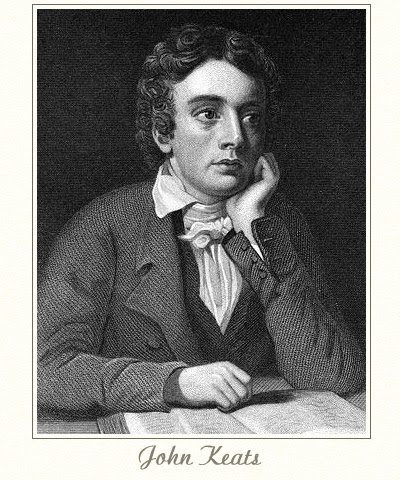
Saturday night, when deluged with stuff to do, I decided to go to an art house movie at the Broadway Theater downtown. (This is symptomatic of my procrastination routine -- I tell myself that I work best under pressure.) Anyway, I decided to see a film called "Bright Star" about the poet John Keats and his first (and only) love, Fanny Brawne. It was a period piece (1818) but grittier than a Merchant-Ivory film with more realistic elements. John Keats had only one set of clothes, for example, and his wealthier friend/benefactor had two. Fanny Brawne was a flirtatious clothes horse / amateur fashion designer, so she had an assortment of nice things to wear of her own creation.

Anyway, I did not particularly like the film. The acting was fine, but as much as they tried, the actors portraying John Keats and Fanny Brawne lacked chemistry. (Note to self: if you're ever casting a love story, capitalize on natural attraction by selecting leading roles in a love film based upon actual attraction.)

I also spent a good part of the film trying to figure out the relationship among various minor characters. Who is related to whom? I probably should have done my homework on John Keats' biography before hand, but that would not have been necessary if the writer/director, Jane Campion, had clarified it at the outset.

On the other hand, some of the scenery was gorgeous, and I do have a better understanding of John Keats. The title comes from a poem he wrote to Fanny Brawne -- she was his 'Bright Star.'

And I have to add that it was much better than "Dead Poets' Society," which came out 20 years ago and really wasn't about dead poets at all. (Was I the only person disappointed about that?! Dead poets are probably a fascinating bunch.)

This is part of his most famous poem, "A Thing of Beauty Is a Joy Forever":

A thing of beauty is a joy for ever:
Its lovliness increases; it will never
Pass into nothingness; but still will keep
A bower quiet for us, and a sleep
Full of sweet dreams, and health, and quiet breathing.
Therefore, on every morrow, are we wreathing
A flowery band to bind us to the earth...

Saturday, August 8, 2009

Movie Review: "Julie & Julia"


It's probably too soon to write the review -- I just saw the film this afternoon, and might normally like to let it sink in a little before writing about it -- but I don't want to forget to tell everyone how GREAT "Julie & Julia" was! I loved it.

The screenplay by Nora Ephron was fantastic. The acting was superb. The settings were perfect.

"Julie & Julia" is based on two true stories: chef Julia Child's, of course, in the 1940s and '50s, and a lesser known (practically unknown) blogger named Julie in 2002.

At the beginning of the movie, Julie and her adoring husband move to a dumpy apartment in Queens. She works in a low-level government job answering calls for the Lower Manhattan Redevelopment Project, a job she clearly hates. Seeking meaning and purpose in her life, she decides she will re-create each of Julia Child's 524 recipes over the course of one year and blog about it. Parallel scenes recount Julia Child's evolution from a woman who merely loved eating and couldn't cook an egg to one of the world's most celebrated French chefs.

This is the only movie I can remember seeing in which two couples were happily in love. I can't tell you how refreshing that was to see on a movie screen! The women's husbands were completely supportive, even in their darkest hours, which is never depicted in modern books or movies. I am blessed to have a husband like their's, though I didn't really know for sure that other such men existed.

This will sound over-the-top, but "Julie & Julia" brought tears to my eyes at least three times -- once out of empathetic sadness and twice out of joy.

I can't recommend this movie highly enough.

Sunday, May 31, 2009

Thoughts on Nostalgia and "Up" by Pixar


So I've been seeing a lot of movies lately, each one stranger and more action-packed than the last, but the movie selection all winter was so dismal you can't blame me for going to see three in one week, can you? Even at matinee prices, that's a lot of popcorn.


First we saw "Night at the Museum" (already reviewed) then "Star Trek" (enjoyed it, though I've never been a Trekkie), then "Up," the newest offering from Pixar. I've loved almost everything they've done. (Not too crazy about Ratatouille - other than the art! - or Cars, for whatever reason.) I had heard almost no press about the film and didn't know what to expect.


But I liked it. The problem is, I can't tell you anything about the premise of the movie, because that would spoil the story line, but I will say that at one point the old curmudgeon in the film (voiced by Ed Asner) lets go of all of his nostalgic artifacts from the past and frees himself to live in the now.


Which got me thinking about a statement I heard recently that really caught my attention: Nostalgia is self-destructive. I've been contemplating those words ever since and wondering if they could be true. I don't want to believe the statement is true, because I am a nostalgic/romantic person with all sorts of favorite memories, mementos, journals, photographs, letters, newspaper clippings...everything you could imagine, even an old pony tail (Well, that's really Scott's...well, I mean it's my pony tail, but it's his memento...)


I don't really want to believe that nostalgia is self-destructive, but a case could be made....All right, I think it probably is self-destructive in some ways.


I've done some research on the subject over the past couple of weeks. Cultural critic Susan Stewart said that nostalgia is "sadness that enjoys its own sadness." I don't think of nostalgia as sadness, but I do understand her meaning. She says that nostalgia is "a desire for comfort that blinds us to the urgent present." That's probably true as well.


What do I have to be so nostalgic about? Why am I thinking about this now? I think it has to do with our slowly emptying nest. (Having children over three decades and two millenia - 1989, 1991, 1995 and 2000 - makes for a very gradual but nonetheless emotionally taxing 'empty nest syndrome.' Heaven help Emily when she tries to fly the coop!)


I don't know what I can do about my tendancy toward nostalgia except try to live more in the present, savoring the here and now. That's why I loved the quote I shared last post from Jean Paul Sartre: "Mais it faut choisir: vivre our raconter" (But one must choose: to live or to remember.")


(It's interesting to note that the French philosopher Sartre started out as an avowed atheist. He actually wrote this depressing line: "Everything that exists is born for no reason, carries on living through weakness, and dies by accident." What a perspective! But after he matured he wrote: "I do not feel that I am the product of chance, a speck of dust in the universe, but someone who was expected, prepared, prefigured. In short, a being whom only a Creator could put here; and this idea of a creating hand refers to God." If Sartre had ever met the missionaries, it would have been a match made (literally) in heaven.)

Friday, May 22, 2009

Movie Review: Night at the Museum 2: Battle of the Smithsonian


Every year on my birthday weekend they start releasing summer blockbuster movies, so today for my birthday we went to see "Night at the Museum 2: Battle for the Smithosonian." (I could practically count my birthdays by which movie came out. We'll have a traditional family birthday party/picnic on Monday.)


I kind of liked the last "Museum" movie despite excessive action, which is a common problem with modern movies geared toward ADHD audiences. As I said in a previous movie review post, I can be entertained watching grass grow if the movie gives me something to think about, but many movies today substitute loud noises and special effects for good story lines and dialogue...anyway, I digress.


So I went to the theater pre-disposed to have a good time but not certain that I would, and the good news is -- I did! It was a lot of fun, despite the fact that a few of the jokes fell flat and the entire plot was completely unrealistic. It might have something to do with the fact that I enjoy history in general and museums in particular. (I've always wanted to sleep in one of those period rooms overnight in a big four poster with a heavy brocade canopy and curtains...digressing again.) The art work on the walls of the Smithosonian comes alive in the film (a la Harry Potter), which was also a lot of fun.


The writers on this film must have had a lot of fun imagining what Napoleon, Al Capone, the Thinker, and Abe Lincoln, among others, would say and do. The large cast was great, especially Owen Wilson (important message from him toward the end of the film, given his suicide attempt quite a while ago -- do I sound like a groupie?), Robin Williams (poignant given his recent heart troubles), Amy Adams, and Ricky Gervais. (He's one of those people who is just naturally hilarious. I really enjoyed him in "Ghost Town" last fall, though that movie overall was a little depressing for me and haunted me for days. Now I can't remember why...isn't aging great?)


If you're able to suspend reality completely and just go along for the ride, I think you'll enjoy "Night at the Nuseum 2."

Friday, February 13, 2009

Movie Review: Cranford (BBC Series)

I sat down this morning to finish watching the BBC series "Cranford," which is based on three novels by Elizabeth Gaskell. The story takes place in the 1840s in a small town in England and it's DELIGHTFUL! I can't recommend it highly enough. (I checked it out of the library after waiting to get it from a long hold list...apparently the word is out.)

Anyway, I went looking on the Internet to see if others are as enthusiastic about it as I am and found this very British review by A.A. Gill in the London Times Online. It's so funny I thought I'd post clips of it here in the hope that others will be inspired to watch so that I will have someone to discuss it with! (The DVD is due at the library today or I'd pass it around...)

(You'll see that A.A. Gill is enthralled with an actress in the film named Atkins, but I loved Imelda Staunton the most, who plays a spinster named Miss Pole. I had to hear every word she spoke and catch all of her facial expressions. She is hilarious!)


Here, in part, is A.A. Gill's Review:


I’ve never read Cranford, and, just between the two of us, neither have you. It’s on our list, though, and has been since we were 18 and first discovered we had a list....only the English have a list of books they haven’t read. Mrs Gaskell is a large bra, right at the top of our unread laundry.

...I’m embarrassed by the cringing cultural kitsch of the classic serial.

So, I sat down to Cranford(Sunday, BBC1) girded and gimlet-eyed, my modernist cudgel ready to bludgeon it to a silly pulp. Then, in the very first minute, Eileen Atkins gave me a look – just for a moment, a sideways look, more a glance, really, but it had such depth of character, such promise of interest and intimations of stories to come of hardship and parsimony, of steadfastness, piety, worldliness and a little kindness, all packed together in that one tiny gesture, like an apothecary’s spice box – and I realised it was all up. I was hooked, gaffed, netted and filleted.

Atkins could have me for her tea with tartare sauce. She is the cur’s cods, the terrier’s testicles, the business.


I will go further and declare that Atkins is the finest actor appearing anywhere in the world right now. There is, in her performance, a miraculous ability to project a complex subtext or emotion and motivation in her face and posture, while delivering words that seem real and immediate but, simultaneously, tell us something quite different. With the merest tightening of a lip or flickering of an eye, she raises doubts, opens lines of plot and is able to hold and impart contradictory emotions clearly and profoundly. To be able to do this isn’t just talent or craft or practice, it is an intense sensitivity, an insight into the dilemmas of the human spirit. She is an era-defining actress.

And with her we got Judi Dench. To use a technical term, that was double bubble. Dench was the straight man, the feed, clearing space and giving time to Atkins. It was a performance of immense generosity, born from confidence and the understanding that to listen is as important as to speak; that a part isn’t measured in how many lines you say, but in how many are said to you. Between them, they created scenes of bright brilliance. But then, this was an entire cast of brilliant women, and I could fill the rest of this page with luvvie notes written in violet spittle, but I shan’t.

Cranford is a story of a lot of fairly silly women fussing about things of monumental insignificance...And we have a particularly strong cast of actresses who find themselves in their prime. The reason there are so many of them in Cranford is that the only people who will write decent parts for them are dead lady novelists, and that’s not just a shame, it’s a sinful waste of a great national resource.

Sunday, January 11, 2009

Movie Review: Bonneville, 2008


I was excited to see the movie "Bonneville" from the time I heard what it was about when it was released last summer. It's a road trip movie (and I almost always enjoy those) about 3 Mormon women traveling together, which sounded like an interesting premise. Unfortunately, despite both of these elements and some spectacular scenery (mostly in Utah), I really did NOT enjoy it. (Though it is a movie about Mormons, it was made by 20th Century Fox.)

So right now I am experiencing 'movie letdown.' This is a familiar sensation for me -- I buy into a movie scenario whole heartedly, imagining possible plot twists and character dynamics, but when I actually see the film, I discover that the screenwriter or director or actors (or all three) failed to live up to the concept's potential.

In the case of "Bonneville," I would pen the blame on the screenwriters. The actors did the best they could (Jessica Lange, Kathy Bates, Joan Allen and Christine Baranski), which implies that the director was doing his job. The cinematography was excellent -- so it was the script that lacked substance and plausibility.

What exactly bothered me about the film?


  • Carol, the most devout of the three women, was stereotypically uptight and humorless. In my own experience, devout people have depths of emotion. If anything, they take more meaning from life and experience it more profoundly.

  • Marjean, the rebel, reveals her coffee and Scotch drinking habits to the other two women as soon as they've left Pocatello city limits. These are women she has supposedly been intimately acquainted with for decades.

  • The whole purpose for the trip is never resolved. Never! Quite a disappointment after nearly two hours.

  • Details...like driving away from Bryce Canyon when they're supposed to be driving toward it...Like dropping a hitchhiker off in the middle of no where...Like meeting up with a big rig trucker in three states and on schedule.

  • Too much time spent mourning. It felt more like a drama than a comedy.

This review would not have discouraged me from seeing the film -- that's how much I wanted to see it. I have a feeling I will remember it more fondly with time.

Saturday, April 12, 2008

Movie Review: Miss Pettigrew Lives for a Day


I saw this movie two weeks ago and have thought little about it since, though some aspects of it have annoyed me into writing a review afterall.

It's the story of a middle-aged woman (Frances McDormand of "Fargo") in London just as WWII is breaking out. She's been unfairly dismissed from her position as governess and needs work desparately, but her employment office is unwilling to refer her to new clients, so she surreptitiously acquires the card of a singer who needs a social secretary and goes directly to her apartment to apply.

Amy Adams ("Enchanted") plays Dylesia Lafosse, a young, beautiful, strangely innocent yet amoral stage actress who will do anything to make it big on the London stage. When Miss Pettigrew arrives Dylesia is in a state of panic, trying to simulatneously expel an important overnight paramour and clean the apartment before her official boyfriend returns. Miss Pettigrew starts working immediately, covering for Dylesia with all male parties and hiding evidence of Dylesia's infidelity under the rug. Miss Pettigrew earns Dylesia's devotion within the first twenty minutes of their meeting, becoming a much appreciated, indispensable assistant to her.

As the movie progresses (all of it taking place in a 24-hour period) Miss Pettigrew acquires a new dress, attends a high-brow fashion show, and meets the third man in Dylesia's life, who proposes marriage to his beloved and is instantly rebuffed.

So what annoyed me? Gratuitous nudity, for one thing - just enough to titillate the director, I presume, while preserving the movie's PG-13 rating. I also found the script to be lacking action (and if I thought it lacked action, it really lacked action. Given the right circumstances, I can be entertained watching grass grow.) But more than anything I was annoyed by the implication that Miss Pettigrew wasn't living, really living, until she enterred the chaotic world of Dylesia Lafosse. Miss Pettigrew had been living all along - less fashionably than Dylesia, but living nonetheless, and with a great deal more peace and self-respect. I believe it's always best not to assume that one person's life is any better than another person's life. Everyone has a life, and every life has ups and downs. Miss Pettigrew exhibited maturity, perseverence, independence, and a constancy of character all of the other characters in the movie lacked.

Despite this negative review, I would recommend this movie as an inexpensive rental to be viewed on a rainy afternoon. It has its humorous moments.

Saturday, April 5, 2008

Movie Review: Nim's Island

Just home from seeing Nim's Island.

Thumbs up - I liked it. You have to be willing to suspend disbelief and accept some outrageously improbably events, but if you can successfully do that (i.e., if there is a child still inside you somewhere...) it's an entertaining movie. (And it wasn't completely implausible - all motives were well explained.)

It's the story of a girl named Nim (played well by Abigail Breslin) who has lived her entire life on an island in the South Pacific with her marine biologist father. They harness solar energy for electricity to communicate with the outside world. While he's gone on what is supposed to be a two-day field trip, Nim begins answering questions online from her favorite writer, a reclusive novelist researching a story on volcanoes. (Jodie Foster plays the writer, a rare comedy role for her.) After an injury, she tells the novelist that she is 11 years old, hurt, alone, and fearful that her father will not return in time to save their island from 'buccaneers.' After trying to arrange for help from the safe confines of her San Francisco home, the novelist decides that she will go save Nim herself...a difficult proposition for someone who hasn't had an actual adventure of her own in years, perhaps ever.

I wanted to see the movie, in part, because I loved Swiss Family Robinson so much as a child, and this movie did remind me a little bit of that one (a treehouse, friendly, cooperative animals, etc.) Both movies inspire my imagination. They make me want to go live on a tropical island myself.

Wednesday, March 5, 2008

Movie Review: Juno

Before the movie I was debating which film to see: Juno, which I had heard good things about, or Bonneville, which I had also read good things about. I asked the ticket sales clerk which she would recommend. She said, "I've heard Juno's funny, if you're not easily offended." Hmmm, well, I'm not easily offended, so I chose Juno.

I expected it to be an edgier "Napoleon Dynamite," a charming, coming-of-age reflection. Wrong! Juno was entertaining and well acted, but watching it I felt like I was wearing a shock collar. Could the heroine be more insensitive and irreverent? I don't think so. Nonetheless, she was realistic, I suppose, and that's something. I never was 'that kind' of teenager myself (the mouthy kind) and never particularly liked that kind of teenager, but, hey, they're out there and I applaud Juno for being realistic.

It also deserves kudos for its no-doubt unintentional anti-abortion message. Why waste a perfectly good baby? Juno continues to attend high school while carrying the baby to term, then wisely gives the baby up for adoption. Her monotone lack of emotion throughout the film indicates that she is emotionally scarred herself by her own mother's abandonment, which is mentioned in the film's first scene.
The couple who wants to adopt Juno's baby are caught in a stifling marriage. Juno relates primarly to the man who wants to be a kid again, but ultimately recognizes and rewards the maturity of the woman, who needs Juno's baby in order to release a lifetime of pent-up emotions.
Bleeker, the father of Juno's unborn child, is a normal high school student, outside of his association with Juno. She has singled him out as someone special. Despite the pregnancy, their relationship continues on an adolescent trajectory toward an uncertain future.
The film is really about dealing with adult pressures from an immature position. It's an exposee on why not to be sexually active until you have your own nest and someone you love to feather it with you.
At the climax of the movie, Juno declares to her father, "I need to know that it is possible for two people to stay happy together." In Juno's world, there is little evidence that such a possibility exists.
Juno summarizes the film in one line when her step-mother asks where's she's been: "Out dealing with things way beyond my maturity level." I think that about sums it up.
If you can disregard the shock value punctuation thrown into the script, the movie may be worth seeing.

Friday, September 14, 2007

Home Alone Watching "Old Joy"

It's Firday night and the entire family is gone to watch the local high school football game. I stayed behind to watch an 'art film', Old Joy - I haven't decided yet whether or ot to recommend it in a general way. (I would recommend it to a very particular audience.) But it has me thinking...

The most thought-provoking concept in the film for me was the statement: 'Sorrow is just warn-out joy.' If that is true, and I would say that in many cases it is, then it makes sorrow more bearable and even a bit beautiful. Maybe human beings can learn to see through sorrow to the joy that makes sorrow more exquisite.

The film is about old friends, both male, who have moved on with their lives but get back together for an overnight camping trip to a place called Bagby Hot Springs in Oregon. They seem to have little in common, except that they were roommates at one time in the past. The man who appears to have his life in order, with a job, a wife, and a baby on the way, is riddled with internalized questions, while the Rip-Van-Winkle, 21st century hippie beleves he understands everything at a metaphysical level. (He may understand reality, but he avoids it at the same time, using drugs and alcohol in virtually every scene.)

The movie poses the following questions: What is friendship? Why do we care about old friends who really have little place in our current lives? Can two people of the same gender touch without sexual meaning? Why is nature therapeutic, even healing?

I only stopped watching the movie an hour ago, and already it is growing on me. It's the kind of movie that feels like real time, like actual experience. I think that I would recommend it to people who like art films or people who are trying to figure out the nature of friendship and its role in our lives.

Saturday, July 21, 2007

Movie Review: License to Wed

While most of my family members sat reading "Harry Potter and the Deathly Hallows" this afternoon, I went to the movies to see License to Wed. Some of the comic elements were juvenile, yes, but I went in knowing that this was not going to be great cinema. It was exactly what it purported to be: an entertaining diversion and a chic flick.

John Krasinski and Mandy Moore play an engaged couple who are very much in love. This requires a chemistry that is difficult to project, but they made a convincingly adoreable couple. I was familiar with Krasinski's ability as an actor, but Mandy Moore was a pleasant surprise. Robin Williams, in his role as Father Frank, was typically over-the-top in his performance. He was somewhat unpredictable, nonetheless, which is always welcome in chic flicks. He looked older in this film than I had seen him before, and I liked his more mature appearance. He reminded me of an older Mickey Rooney.

Call me old-fashioned, but the only truly offensive aspect of the film to me was its repeated assumption that all couples engage in premarital sex. While the vast majority of couples may sleep together before marriage, there are thousands of couples who observe more traditional standards, and their numbers are on the rise again after decades of decline. I suppose in Hollywood it would have been considered grossly unrealistic to expect the couple to be in love without having sex -- they are probably not even aware that anyone in the real world ever waits. I was pleased that the film did at least point out that statistically couples who live together before marriage are much more likely to divorce. The film's oddly averse attitude toward divorce (one character's divorce was treated as a great moral failing) seemed at odds with its anti-abstinence position.

So if you are a) female, b) not expecting high drama, and c) not severely offended by the assumption that there is no such thing as wedding night consummation anymore, I can recommend this movie to you. *** (out of 5)